Showing posts with label Indonesia. Show all posts

Friday, June 27, 2014

Southeast Asia: Same Same but Different

Ok, so as promised, some closing thoughts on Southeast Asia, but first a world geography refresher in case you are like me...


Prior to buying our "Southeast Asia on a Shoestring" guidebook I thought Southeast Asia was Thailand, Laos, Cambodia and Vietnam.  Flipping through the pages, however, I quickly learned that it is those four countries PLUS the Philippines, Malaysia, Indonesia, Singapore, and Myanmar/Burma, all of which we visited, as well as East Timor and Brunei, which we did not visit.  


And now my closing thoughts:


There's this saying in several Southeast Asian countries: "Same same but different."  We heard it used in a number of different contexts and situations.  Some were hilarious like when a girl tried to sell us a bracelet after we purchased some postcards and told us that the bracelet was same same but different.  Others were tragic like when our guide showed us before and after pictures of a village that had been bombed and explained that it was same same but different.


After spending four and a half months in Southeast Asian countries, we realized that the saying also applied to the region.  

There were things that were same same, like rice being a major staple and some countries had overlaps in traditions, language, cuisine, and architecture.  But there was so much that was different, like the economies, the dominant religions, and each country's history.  For example, Malaysia and Singapore have strong economies, especially in contrast with the rest of the region.  The Philippines is predominantly Catholic while Malaysia and Indonesia (which is the fourth largest country in the world) are largely Muslim countries.  Among the Buddhist countries (Thailand, Laos, Cambodia, Vietnam, Myanmar/Burma) we observed differences in practice.  The longer we were in the area, the more nuances we observed. 

Although we've been out of Southeast Asia for almost two months now, I still find myself using the phrase.  I guess the whole world is same same but different.

Tuesday, January 21, 2014

IT'S NOT WHAT YOU KNOW, IT'S WHO YOU KNOW. Part III: Over the river and through the jungle to Turtle Beach we go!


Talk about saving the best for last.  Our final adventure with Supri was a two-day trip out to Sukamade, the home of a leatherback turtle hatchery.  As Brian will tell you, I miss our dog, Lana, terribly and the baby turtles helped ease the pain a little.  But the trip out there was…a wild one.

Sorry, babe.  Even with your beard Lana is still cuter.


I realized that Sukamade must be pretty remote when Supri told us that we needed to stop by the market first to get provisions.

So much to choose from.

We traveled around the market in style!


After stocking up on bananas, watermelon, water, and bread, Supri, Supri's son Toni, Supri's uncle, and us packed into a 4x4 and were on our way.  For the first two hours, we were passing town after town and I didn't quite understand why we needed a 4x4.  Then the towns became farther and farther apart and the paved road became a dirt road.  We drove through a rubber tree plantation and stopped at a "factory" to witness how sugar is made from coco palms.  The government owns the property and provides housing for the workers - 2 families to a unit.  Although the families are technically government employees, they do not receive the coveted pension that other government employees will get upon retirement.    

Here's a rubber tree.  Workers make cuts in the tree and then attach a cup to collect the drippings.

The boiling process.

The cooling process.

The finished product.


The next stop we made was to point out monkeys in the trees above to Toni.  Unlike in China these monkeys are wild, not semi-wild, and have no interest in leaving the tree tops.  It hit me then that we were going deep into the jungle.  Like George of the Jungle type jungle.  Despite having a 4x4, we took our time on the windy, rocky, narrow, and steep road.  Fortunately we didn't pass any other cars, just motorbikes transporting bamboo or other goods.  If we had encountered another car, one of us would have had to back up to a place wide enough for cars to pass each other.

As the road started to level out a bit, Supri explained that we were getting close to the rivers.  There are two ways to get to Sukamade -- the short cut is to cross 3 rivers, but if the rivers are too high or the currents too fast because of all the rain (it's rainy season in Indonesia right now - go figure!), then you get there by boat.  To say I wasn't anxious would be a lie, but the thrill of adventure was much stronger.  We made it across the first two rivers without a hitch.  The third river was too precarious, however, so we turned around, went back across the second and first river again, and boarded the boat to get to Sukamade.  And by boat, I mean bamboo raft.  

Crossing river #1.

Ensuring that it's safe to cross river #2.

Aaaand river #3 was too deep.

The boat that took us across the river.


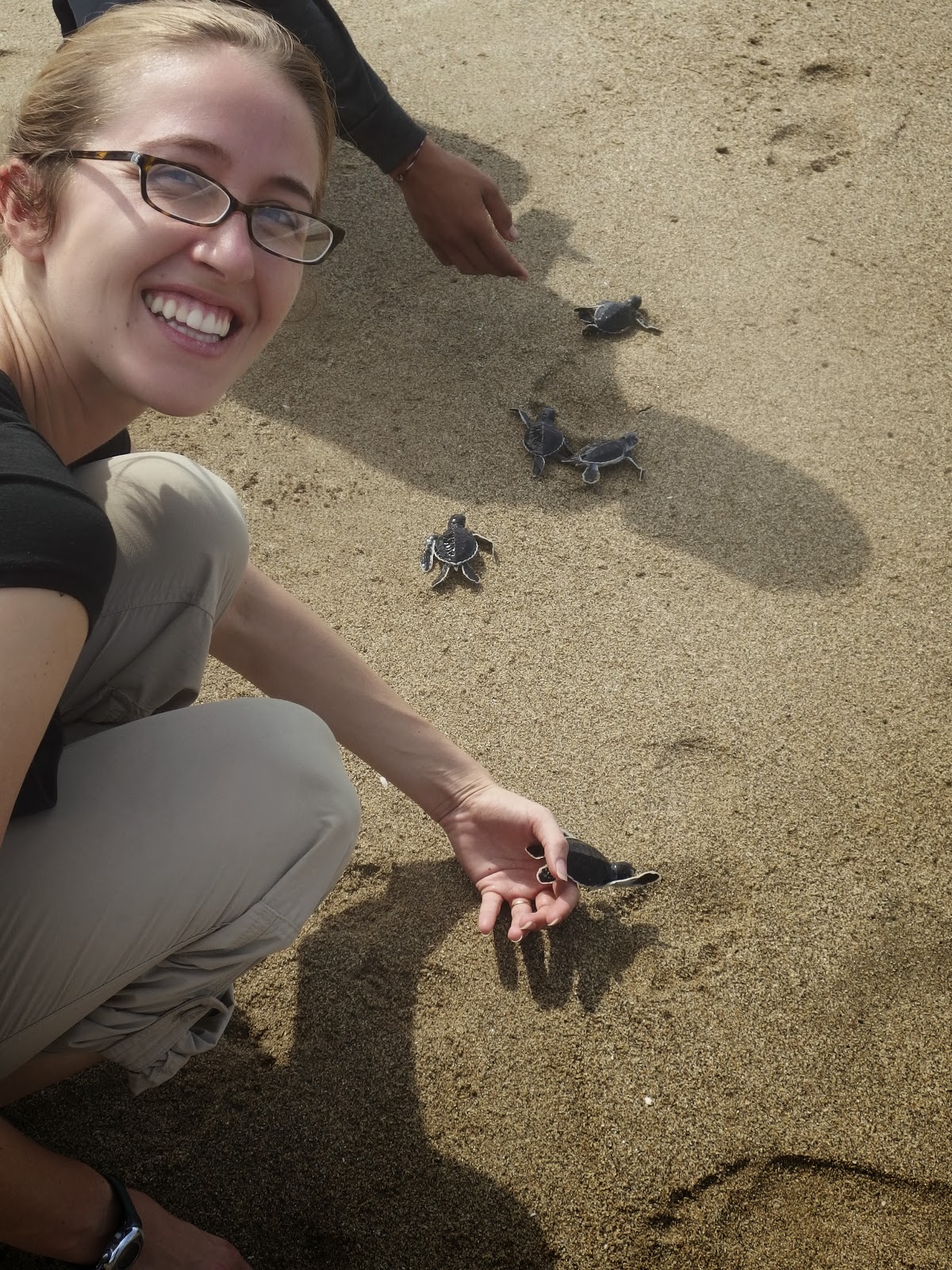
Once on the other side, we had about 1.5km trek through the jungle in the rain to the turtle hatchery.  We passed wild pigs (Brian told me to stand behind him if they attacked - what a man!), horn bills, and more gibbons.  Once we arrived, it was all worth it.  About a dozen turtles had just hatched and were flopping around.  It was amazing to see these little creatures and to feel the strength in their flippers.  When we got to release them into the ocean 30 minutes later I was amazed -- they knew just where to go and beelined for their new home in the Indian Ocean.  The stunning sunset definitely added to the magic.

Trekking through the jungle.

We made it!

Can i keep it??

Turtles hanging out in the hatchery.


Off they go!

Brian rescuing Toni.  The riptide was strong.


After a quick dinner of nasi goreng (fried rice), we went back out to the beach where the rangers started looking for a mama leatherback turtle laying her eggs.  It wasn't long before they found one and called us over.  When we got close enough to see her, I couldn't believe how big she was.  I'd estimate that if Brian curled up in a fetal position, she'd trump him.  It was also incredible to see all the work she had done to protect her babies.  Upon coming to shore, she had dug two fake nests to distract predators.  Once she was finished laying her eggs (she laid close to 120), she then started the process of covering up her nest (she pushed the sand back with her front flippers and then used her back flippers to shovel it into the hole) and creating one more fake nest before heaving herself back to the ocean.  Watching her leave, it was painstakingly obvious what an ordeal she had just gone through.  With labored breaths, she would drag herself forward 10-12 strokes and then she'd wait a couple minutes before she'd move again.  When she finally reached the ocean, she just waited for a wave big enough to carry her back out to sea.     

Watching.

 The mama and her eggs.

Counting the eggs.

Making her way back home.


The next morning, after a quick swim on the empty beach, we released another batch of baby turtles.  For every 100 that are released, the park estimates that only 3 make it to adulthood.  This seems like a low number, but the statistic would be even lower if the rangers didn't rescue the eggs from predators (both people and animals) that feed on them.  

So you don't get confused: Brian's tracks are on the right, the turtle tracks are on the left.

This one was clearly anxious to get into the water.


Driving back to Banyuwangi, I was still in awe of what we just participated in.  I didn't grow up on a farm, so the closest thing to a live animal birth I've seen is probably when Jim Carey climbed out of that mechanical rhino in Ace Ventura Pet Detective.  No matter how much I try, there aren't words that can capture the surge of emotions I felt watching the mama leatherback and releasing the babies.  

It's crazy to think that we almost missed out on one of the most incredible experiences of our trip because a book said there was nothing much in a town.  It just goes to show you that it's not what you know, it's who you know.  

Brian and Supri, the man who showed us all that Banyuwangi has to offer.

Friday, January 17, 2014

IT'S NOT WHAT YOU KNOW, IT'S WHO YOU KNOW. Part II: Hi-ho, hi-ho, it's off to Ijen we go.

When our alarm went off at 12:10am, Brian and I wasted no time getting up to go hike Mt. Ijen.  Our first excursion with Supri a few hours earlier had been fantastic and we were eager to see what the day held in store.  The drive to Mt. Ijen was a steep one (I'm pretty sure the road was at a 45-degree angle in some places), but we were lucky for two reasons.  1) - we were in a 4x4 and 2) the road is now paved.  We arrived at the trailhead around 1:30am and started our ascent of the mountain.

Mt. Ijen is one of Indonesia's many volcanoes (it was last active over 10 years ago), but it has some very unique features.  It's one of two places in the world where you can see blue flames (the other is Alaska).  As I understand the science of it all, the blue flame is because of the burning sulphur pouring out of the volcano.  During the day the molten sulfur appears red, but at night it's blue.  Ijen also boasts of the world's largest acidic volcanic crater lake that is a gorgeous turquoise.  And last, it is an active sulfur mine.  

As we were hiking up, Supri went into more details about the men of Mt. Ijen.  There are about 200 miners who carry on average 60-90 kilos (130-200lbs) of sulfur out of the crater in either baskets or bags.  For each kilo they bring down the mountain, they earn 800 Rupiahs, or $0.06.  They usually make the trip twice a day, bringing their daily earnings to a whopping $8.00-$11.00.  

It wasn't long before we saw the beam of a miner's headlamp slowly bobbing its way toward us.  Supri instructed us to step off the path and when the miner got closer, I could see why.  The picture in my head of the miners was of big men with baskets or bags on their backs.  The reality is that the miners are around my size and they balance a pole with a basket or bag on each end on their shoulders.  While I stood there gapping at the miner's fortitude, Supri switched roles from our guide to the miner's comrade.  He carefully poured some Sprite into the miner's mouth and then told Brian to give him one of the cigarettes we had purchased for the miners as a small token of our appreciation for letting us insert ourselves into their daily routine.  After a quick photo, the miner continued his trek down to the weighing station and we worked our way to the lip of the crater where we caught our first glimpse of the blue flames below.  

A number of the miners work the midnight shift to avoid the sweltering sun.

The burning blue sulfur flames from the top of the crater.


The descent into the crater was challenging not only because the path was littered with loose rocks, but also because of the lingering and nauseating sulfuric gases that permeated the air.   Again, I found myself in awe of the men who called this their daily commute.  It was nearly 4:00am by the time we reached the crater floor, but still dark enough to admire the blue flames.  After feeble attempts to capture the beauty on film, Supri led us to the workers' tent.  He explained that most visitors make the treacherous hike down to the crater to see the blue flames and then hike back out in order to see the sunrise.  Once they see the inside of the crater in daylight, however, they want to climb down again.  So, we were just going to stay put, wait for dawn to break, and enjoy our visit with the miners.  While I watched the miners pour molten sulfur into molds to make souvenirs (by selling just one of these they can earn what they would for porting a load of sulfur), Brian went back outside to visit with some of the men and give away more cigarettes.


I told you they were feeble attempts…


This one is a little better (it's the light blue stuff on the left).


Chilling (Brian says we were sleeping...I say we were chilling) in the miners' tent.

The miner-turned-artist at work.

The souvenirs.  The flower on the left is still cooling down, hence why it's more orange than yellow. First person to post a comment on this blog post is guaranteed to get one ;-)


When the black night was finally replaced by the blue glow of dawn, Brian and I felt as if we were on a different planet.  The ground beneath us was carpeted with fragments of yellow sulfur, the walls of the crater were tones of shimmering white and gray, billowing clouds of sulfuric gas escaped from the earth and filled the sky, and red molten sulfur dripped out of pipes.


Ijen in the light of day.


By this time more miners had arrived and were busily gathering slabs of sulfur and arranging them in their baskets for optimal balance.   A few had on boots and masks, but the "uniform" seemed to be flip flops, pants, and t-shirts with the occasional scarf wrapped around their heads or mouths.  Other visitors were now starting to come down into the crater to take pictures of the men at work, but, aside from Brian, no one was engaging with the miners.  

Brian hanging out with his boys.  If you look closely, you can see a white spec in the mouth of the miner on the left -- he was already smoking the cigarette Brian gave him.

 How to mine sulfur. Step 1: Find a good slab of sulfur.

Step 2: Break the slab of sulfur into smaller pieces.

Step 3: Carry the smaller pieces to your basket. 

Step 4: Strategically load the sulfur into your basket.


The climb out of the crater was not as unnerving as the one into it, but then again we weren't carrying upwards of 130lbs.  We continued to pass miners along the way, including one who has been working the mines for forty years.  Some were resting, some were carrying a load of sulfur, and some were en route to fill their baskets.  By the time we reached the lip of the crater, we were out of cigarettes and almost finished with the bottle of Sprite.  

Hiking out of the crater.

The view from above.  The blue in the background is the lake.

The miner on the right has been working there for 40+ years and is very proud of that fact.  He still wears only flip-flops despite having broken several of his toes over the years.


As we were making our way down the mountain, we overheard a visitor watching from the lookout say that after witnessing the miners' working conditions, she was never going to buy white sugar again (the sulfur from Ijen is used for vulcanizing rubber and bleaching sugar).  Curious, we asked Supri more about the quality of life for the miners.  Concerning their health, he remarked that when he had taken miners to the doctor, the ailment was most often back or shoulder pain.  He also pointed out that the miners' income is quite good considering their level of education and they make more mining than they would on a rubber, sugar, or cocoa plantation, though the miners are trying to earn 1000 Rupiah for every kilo of sulfur they carry out of the volcano instead of 800 Rupiah.  Supri did note that there used to be close to 400 miners and those who left did so to try to get a better paying job.  

Like the dichotomous nickname for the crater - "where heaven meets hell" - we acknowledge the mining operation as both good and bad, as impressive and oppressive, as more gray than black and white.  Then again, we spent time with the miners; we asked questions, we listened, and we observed.  There's that saying that everything is more complicated than it seems.  What we learned from our morning IN Mt. Ijen is that sometimes to get even just a glimpse of the complexity, you have to delve deep beneath the surface.

Brian took the miners up on their challenge to lift the sulfur.  He was thankful that was all he had to do.

Tuesday, January 14, 2014

IT'S NOT WHAT YOU KNOW, IT'S WHO YOU KNOW. Part I: Supri and his village.

After spending a few days on the island of Bali in Indonesia, Brian and I boarded a bus bound for Banyuwangi on the neighboring island of Java.  The sole reason for going to Banyuwangi was to hike to Mt. Ijen (a volcano) and see the crater.  Although our Lonely Planet guidebook stated that there wasn't much in Banyuwangi and recommended approaching Mt. Ijen from a different town where it was easier to hire a 4x4 (yep, you need one of these to get the trailhead), Brian had a haunch that we should stay in Banyuwangi.  On the ferry from Bali to Java, Brian met a guy who recommended that we stay at Hotel Baru, so that was our destination.  

As soon as we arrived at Hotel Baru, we were greeted by Supriyada, or Supri, a guide, who quickly stepped in to help us resolve the matter of a cracked window in our taxi.  To prevent any incidences of ugly Americanism, we gladly paid the $15 to repair the window and everyone left happy.  We walked away smiling but confused because we didn't remember being that destructive.  Then again, we're big boned compared to Indonesians and don't fit too easily inside their vehicles.  Once that was over and done, we asked Supri about the hike to Ijen.  He said that he could arrange it no problem and then he went on to tell us that he could also show us around his village and take us to the deserted Sukamade beach and the leatherback turtle hatchery.  Our plans to stay just one night in Bangyuwangi quickly changed.

Our first full day in Banyuwangi was spent touring Supri's village.  What I thought was an alleyway off of a main road was actually the entrance to his village, a maze of houses and little shops.  As we enjoyed a traditional meal, Supri explained that Indonesians like sweet food and colorful homes and that they don't smile in pictures.  We found all three to be true.

I think it could use a little more purple, don't you?

Everything on this plate was sweet and delicious!  Our favorite was the black rice.

They smiled before the picture and after the picture, but we couldn't get them to smile for the picture.


The next stop was at the home of one of Indonesia's best and award winning dancers, who not only designs and makes the costumes for Indonesia's version of Carnival and various festivals, but does all the choreography, too.  His costumes were exquisite, some weighing up to 60 kilos (132 pounds).  We were fortunate enough to get to try some of them on and hang out in his workshop where he told us stories about his visits to other countries, including North Korea.  When Brian asked him if the North Koreans liked his dancing and costumes, he replied that his performance brought people together and that was the most important thing.  Pretty remarkable insight.

This is just part of the costume.  The whole ensemble weighs more than I do.

Brian donning the crown for the king's costume.

Playing dress up is for big kids, too.

Ta-da!


Then it was off to Banyuwangi's black sand beach.  The sand on these types of beaches is made of tiny fragments of lava, hence black sand beaches are always found near volcanoes (Indonesia has and has had more volcanoes and more volcanic activity than any other country).  Black sand beaches aren't all that common and so they tend to be big tourist attractions.  However, this one is essentially deserted.  Supri's vision is to start an eco-tourism project that involves cleaning up the beach and putting Banyuwangi on the map.

A traditional fishing boat we passed on the walk to the beach.

Some kids we passed along the way.  Potato guns are cool.  And so are big white guys with beards.

Learning about Supri's dream.

Looking out at Bali from the black sand beach.


Our last stop for the day was the English Learning Center where Supri learned to speak English.  He was one of the first students there along with 6 others back in 1986.  Today there are more than 500 students.  One of the reasons for the increase in students is that the Indonesian government now requires employees to speak English.  We got to visit with one of the classes and had a blast hanging out with the kids.  

One of the name tags at the ELC.  Pure coincidence.

Chatting it up with Udo.  His birthday is May 9th and his favorite color is blue.  

Posing with students for an ELC ad.  It's not every day they get to speak American English with real live 'Muricans.


As Brian and I went to bed that night at the terribly late hour of 7 (we had to get up at midnight to leave for Mt. Ijen, an adventure we'll share this adventure in part 2!), we were both certain that the Lonely Planet staff hadn't met Supri when they visited this gem of a city.