Monday, December 30, 2013

Middle Earth (aka New Zealand)

Since leaving Christchurch on December 3, Brian and I have been driving around New Zealand's south and north islands (actually, Brian's been driving and I've been reminding him to stay on the left side of the road).  While it is possible to get around NZ via bus and train (a lot of people hitchhike, too) and normally that's how we travel, for us renting a car made the most sense.   Not only was it cost effective, but it also allowed us to choose our own adventure every day, which we did :-)


Our car!


We left Christchurch and headed east to Akaroa where we saw the world's smallest dolphin.  Since it's summer below the equator, we were fortunate to get to see the dolphins with their pups.  

Now you can say that you've seen the world's smallest dolphin, too!

What a sunset, huh?!?!


Then we headed inland (and slightly southwest) to Lake Tekapo and Mt. Cook.  Because of all the cloud cover and the likelihood of rain, we didn't climb Mt. Cook and instead settled for looking at the nearby glacier.  Bummer, huh?

Just some free poo along the road (the sign is pointing to manure...not Brian).

These "weeds" lined the road for kilometers.  I loved them!

Those are glacier chunks behind us.

The color of Lake Tekapo was breathtaking.


After a stunning drive from Mt. Cook, we headed southeast to Oamaru and penguins!  We got to watch rafts of penguins swim in to shore and make their way to their nests.  It was hilarious to see them hop up the rocks and then make a waddling dash to their next hiding place.  If anyone needs ideas for what to get me for my birthday, I'll take a penguin.  (Unfortunately, we couldn't take pictures of them up close because it scares them so you'll just have to trust me when I say they are awfully cute.)

You know a town is serious about their penguins when they've got penguin crossing signs.

Since we don't have pictures of the penguins, here's one of the many lambs we saw on our drive to Oamaru.  They're pretty cute as well.


Dunedin was our next stop and then we continued the drive south through the Catlins (it's an area, not a city) to Invercragill.  For us, the drives were often more exciting than our final destination for the day.  In the Catlins, we got to see the yellow-eyed penguin, the rarest penguin in the world, up close and personal.  

One of the many beaches we passed along the way to Dunedin.

Brian will take penguins over monkeys any day.

The yellow-eyed penguin.

Another pit stop during our drive to Invercargill.


Having reached the bottom of the south island, we started to head north again to Te Anau.  There we got to do some great hiking.  New Zealand has these hikes called the Great Walks.  They take a couple of days.  We didn't plan well enough to be able to do any of the Great Walks, but we did get to hike on parts of the trails...so that's kind of like doing the Great Walks ;-)

Brian being manly.

On the Kepler Track.

At Key Summit on the Routeburn track.


Continuing our drive north along the western side of the south island, we stopped in Queenstown and Arrowtown.  A number of scenes from Lord of the Rings were shot in that area so naturally Brian and I went to see The Hobbit in Arrowtown.  Then it was off to Wanaka.  The first time Brian told someone we were headed to Wanaka (pronounced Wah-nah-kah), he pronounced it Wayne-kah and everyone thought he said "Wanker."  Oops.  Thankfully Kiwis (NZ citizens) have a great sense of humor and Brian's mispronounciation resulted in us being invited to dinner so they could more of our American accents.

At the theater in Arrowtown.  Easily the coolest theater we've ever been to.


NZ lost a tenth of its population in WWI (one of the highest casualty rates per capita of any country), so just about every town has memorials to the men it lost in battle.  This is the one in Queenstown.

Anyone recognize this from Lord of the Rings?  (Hint: It's in the first film and the scene is with Elijah Woods and Liv Tyler)

We found Rocky Mountain!  Just one mountain though...

At the top of Rocky Mountain.


It was a good thing we'd been doing a lot of hiking because our next stop was Franz Josef, where we hiked a GLACIER!  This was undoubtedly the highlight of our time in New Zealand and one of the most magical experiences of my life to date (marrying Brian was another...).  Our guide had taken a break from glacier guiding for three years.  When he returned in 2013, he was shocked to find that the guiding company was no longer hiking to the glacier but instead flying people onto it because it had receded that drastically.  

Brian suiting up.

Getting briefed on how to walk with crampons on.  To get some perspective on how big the glacier is, look for the other group behind our guide's head. 

Just hanging out on glacier.


We left Franz Josef and went from glaciers to beaches in just a day.  We continued our drive north with a night in Westport to break up the trip to Motueka and Abel Tasman National Park.  After doing another (part) of the Great Walks, we left for Picton where we caught the ferry on Christmas day from the south island to the north island.
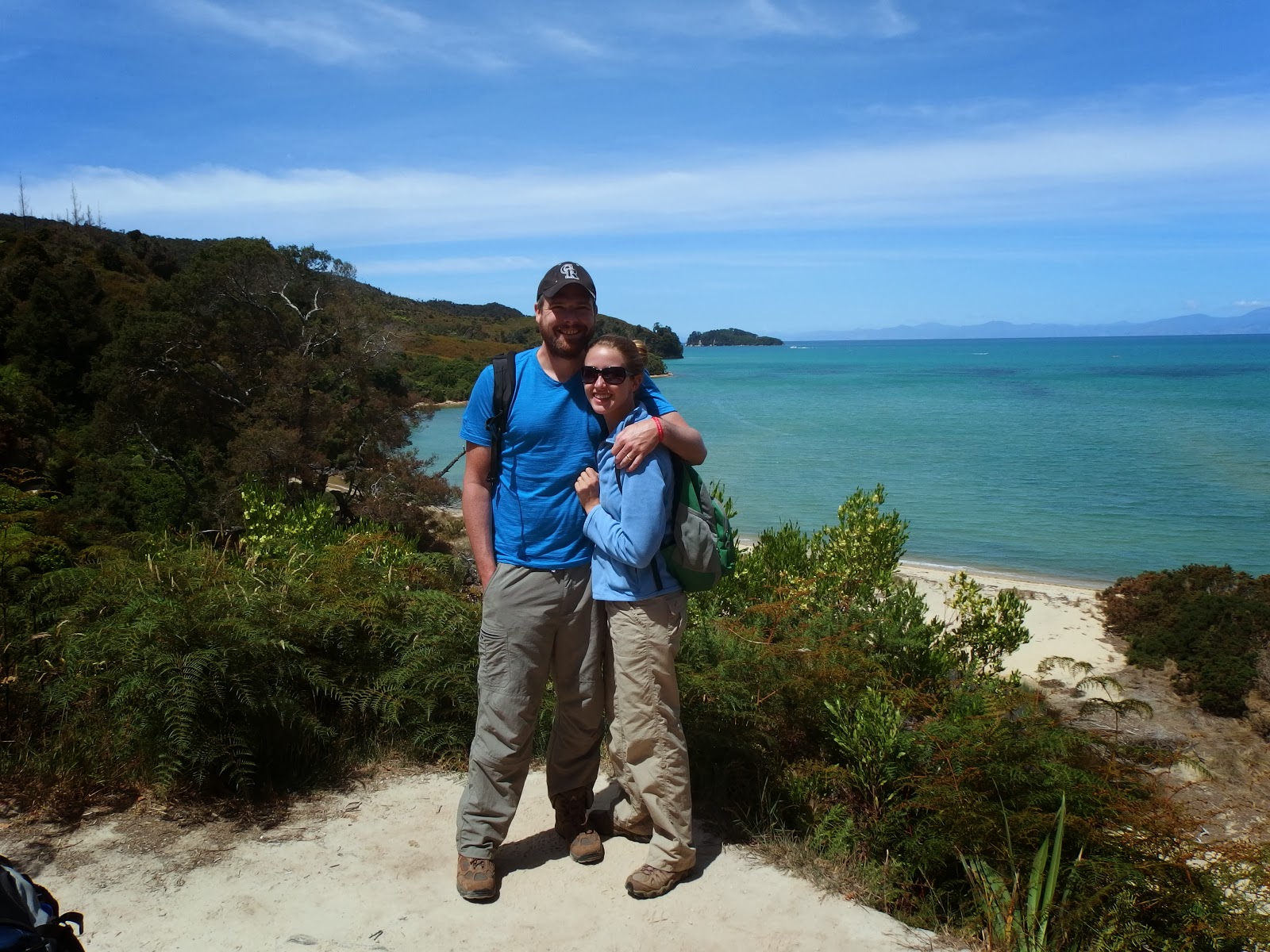
Hello sand and sunshine!

Brian being manly.  Again.

Merry Christmas!


Our first stop on New Zealand's north island was Wanganui and then we headed to Rotorua.  In Rotorua, we visited geothermal sites and a Maori village where we fortunate enough to get to see a cultural performance and eat a traditionally prepared meal.

Enjoying the sights (but not the smells) at Wai-o-Tapu Thermal Wonderland.

More of Brian's manliness.

Performers at Whawarekarewa.  Maori still live in the village and the performers are all descendants of the village.  We got to see a haka and also learned that Maori greet others by pressing noses together twice -- doing so forces a closeness.  Pretty cool.

Villagers use the geothermal activity to cook their food.  So much better than ovens or crockpots! 

With the exception of the gravy, this whole meal was prepared using the method above.  It was fantastic!

Villagers use the water from this natural pool to bathe.  Because of all the good stuff in the water (I'm not a scientist - sorry!), Maori rarely have skin problems.  How awesome is that?!


And now Brian and I are chilling in Auckland, waiting for 2014 and our flight to Australia on New Year's day. 

New Zealand has done more than just stun us with its beauty.  This country that is home to more than sheep than people has made nature's fragility painstakingly clear.  There's a hole in the ozone above New Zealand.  A foreign algae is threatening the rivers.  Native species are endangered because of rodents brought here.  The glaciers are disappearing.  It's both sobering and motivating to think that our children (if we're blessed to have kiddos) won't be able to see what we've seen or go where we've gone unless we make a stronger effort to preserve and conserve.  

Before we sign off from NZ, we want to send this message out to everyone: 


We hope your year gets off to an amazing start!

Tuesday, December 17, 2013

ChCh & the 3 R's

From December 3-6, Brian and I were in Christchurch, New Zealand (abbreviated ChCh).  If the name rings a bell, it might be because you heard about the earthquakes here back on February 22, 2011 that killed 185 people and damaged or destroyed 100,000 buildings.  Walking around, however, you would think it hit more recently.  Some buildings have been repaired or newly built; many still lie in ruins or have been sealed off since 2011 thus becoming a time capsule.  When tragedy befalls a place, we often hear about the rescue and relief efforts and that's when we are most generous with our prayers, time, and resources.  But, as we discovered in ChCh, the third R - the rebuilding - is just as important, just as involved, and can be just as painful.


The markings were how rescue workers communicated when buildings had been cleared and if there were fatalities.  These buildings have been sealed off since February 27, 2011 (27/2) and February 24, 2011.  


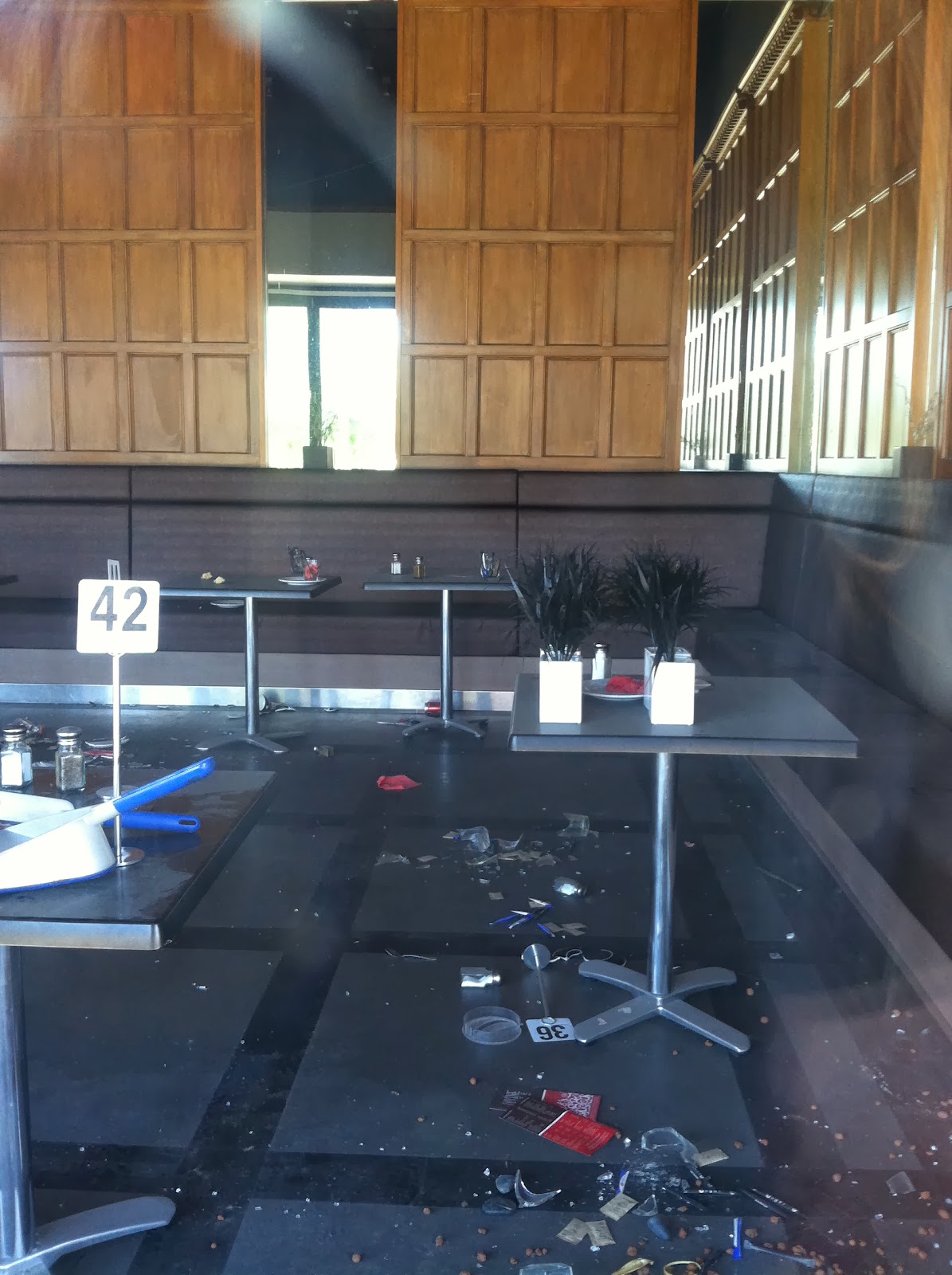
Inside a restaurant that's been untouched since 27/2.


Construction equipment outside a damaged building.


Christchurch's cathedral.  There's a lot of controversy about whether to demolish it or restore it.


In an attempt to add beauty to painful reminders of 22/2, spaces have been reclaimed with creativity and other art.   


ChCh's trolley just started operating again a few days before we arrived.  


The outside of Restart, a shopping area.  Until their permanent locations are rebuilt, stores and restaurants occupy shipping containers. 


The Philippines: Home to jeepneys, cockers, and Mamaley


Well folks, I am way behind.  We're currently in New Zealand and I have yet to tell you all about our adventures in the Philippines (November 15-29).  My apologies!  We caved and bought a MacBook Air so that we could better manage business and upload all our pictures.  When not driving through Middle Earth or calculating our internet usage (in NZ you are charged for internet based on megabytes), we've been busy importing and sorting our photos.  The good news is that we're making progress and that you now get to view better pics than what we can take with an iPhone!

So, without further ado, the Philippines!

The Philippines are made up of 7,000 islands and the islands are divided into three groups: Luzon, Visayas, and Mindanao.  We traveled to the Luzon and Visayas islands.  We flew into the city of Manila on the island of Luzon (and in the Luzon island group).  A few days later we flew to the island of Palawan where we spent most of our time.  Palawan is in the Visayas group of islands.  There we visited the cities/towns of Sabang, El Nido, and Puerto Princesa.  Last, we flew to Cebu, also in the Visayas island group, and stayed there for two days before heading to the land down under.  

MANILA
Manila is the most densely populated city in the world, though after visiting some of China's cities it didn't feel as overwhelming as one might expect.  What was jarring, however, were all the street kids.  In China, the elderly and disabled constitute the homeless and beggars.  In the Philippines, it's children.  I'll never forget this one toddler in only a diaper and sucking on a pacifier who followed us about 100 feet with an outstretched hand.  It took me a moment to realize that he didn't really know what he was doing - he was just mimicking the behaviors of other children.  Still, it was tough to stomach the fact that this baby knew how to beg before he knew how to speak.

While Manila introduced us to poverty in the Philippines, it also gave us our first glimpse of the country's beauty.


Volunteers at the Manila Red Cross packing up food and supplies for typhoon-devasted areas.


Spanish-style buildings are at every turn in Intramuros, the historic part of the city. 


A sunset from the bay.


SABANG
After two days exploring Manila, we hopped over to the island of Palawan.  Whereas Manila is nicknamed the concrete jungle, Palawan, known as "the last frontier," is anything but.  To get to our first stop, Sabang, we jumped aboard a jeepney and stared out at rice fields and lush, green jungle as we drove on gravel roads for almost four hours.  Although it was nearly dark when we arrived, there was just enough light to see Sabang's beautiful beaches and just enough time left before the electricity went out to get our mosquito net set up in our bungalow (in Sabang there's no electricity after 10pm).

Check out our sweet ride!  (minus the Chargers...)


A real live rice field!


The beautiful beach at Sabang.


The next day we explored the Underground River, one of the New Seven Wonders of Nature.  This UNESCO World Heritage site was jaw-dropping, but as our guide kindly reminded us -- when adventuring in caves with bats, it's always best to admire with mouths closed!  Since our camera isn't one of those super-duper high tech ones for National Geographic and the like, our pictures inside the caves are pretty lousy, but if you google it you can find some great ones.

Hi mom!


This is what it looks like at the mouth of the Underground River... 


...and this is what it looks like inside if you shake your head (I told you our pics were bad). 


Brian also explored mangroves with a local legend, George.  George got lost hiking through Palawan one time and a tribe took him in. 
Brian and George (of the jungle).


EL NIDO
It was a long and bumpy road to El Nido, but completely worth it.   El Nido is nicknamed heaven on earth because of its beauty.  Ta-da!


This was the view...from our bed!


Our friend Lauren is from El Nido and encouraged us to go visit when we told her we'd be in the Philippines.  Many years ago, her grandmother, Mamaley, found German travelers sleeping on the beach.  She opened up her home to them and thus was born "Gloria's Cottages," the first & only of its kind in El Nido at that time.  Mamaley still has the original sign as well as many other artifacts in her collection.  Talk about adventures!  She has on display pottery that's hundreds of years old that she found while exploring caves, memorabilia from General MacArthur's home, and traditional Filipino dresses that she wore back in the 1940's.


The Plums and the famous Mamaley.

When we weren't entranced by one of Mamaley's stories or off exploring waterfalls, hot springs, lagoons and secret beaches, we were enjoying the best El Nido has to offer - her people.  Brian spent several days with Lauren's uncle, Rico, who is a famous cock fighter.  Cock fighting is legal in the Philippines and, as Brian learned, is a serious sport.  Ever the sports enthusiast, Brian made the keen observation that at the cock fights people from all economic backgrounds rubbed elbows, but in the States classes tend to be divided by box seats and nose bleed sections.  He also discovered that there's a science to raising and training roosters as well as to picking winners.  It took Brian some time to learn this science (i.e., he lost), but he won a lot of friends.  By the end of our time in El Nido, we couldn't go anywhere without someone coming up to him to ask how he made out or if he was going to the next fight.     

Taking a dip in the jungle.


 Rico and one of his fighting cocks.  And yes, that is the rooster's home in the background.


The fighting is about to commence...

While Brian was off with the men trying to earn his keep as a cocker (that's what you call a cock fighter), I was at home with the ladies who were kind enough to let me hang around while they worked.  El Nido is without power from 6:30am to 2:30pm every day which means that my new friends went about their business the old fashioned way.  I watched them do the laundry by hand, manage reservations with paper and pencil, and kindle a fire to cook over.  At first I thought the lack of electricity was a hindrance, but after a few days I realized that it was what helped to keep life in El Nido wonderfully simple.  And then I started to wonder what was the "electricity" in my life?  What complicated instead of simplifying as I assumed it did?  It's a good question to be struggling with.    


Watching the Pacman fight.  You better believe that the generators were on all over town!

It was tough to leave El Nido.  We were only there for a few days and yet it felt like we were with family and old friends.        


PUERTO PRINCESA and CEBU CITY
To ensure we didn't miss our flight from Palawan to Cebu, we got there the day before and spent the night in the capital city, Puerto Princesa.  We had good conversations with a retired Marine and former Peace Corps Volunteer also staying at our guesthouse and Brian led a group of elementary schoolers to victory over the big kids in a game of basketball.  

Brian rallies his team. 


Semper Fi!


Then it was off to Cebu.  

Being in Cebu, a transportation hub for Yolanda relief efforts, brought us yet another a step closer to the tragedy and so our last few days in the Philippines were not so much filled adventure as with reflection.  Before we arrived in the Philippines my reaction to the storm was sadly superficial - I said, "Wow, that's awful," read a story or two in the news, and then checked to see if our flights were impacted.  Once in Manila, however, I couldn't detach myself as mindlessly.  All the stores had donation buckets and every TV & radio station was broadcasting something related to Yolanda.  We went to the Red Cross to see how we could help and at their request made a donation (without medical training we couldn't really do much else).  As we continued to travel throughout the Philippines, we heard heartbreaking stories at every turn.  Our waiter's mother-in-law survived by climbing up a water tower where she watched her home and friends get washed away.  Our taxi driver was filling in for a colleague who lost twelve members of his family.  Suddenly, the gravity of the situation sank in.  I mourned what was lost, I cherished what was saved.  There's some adage about caring when things are happening in your own backyard.  The Philippines helped me recognize that my backyard is much bigger than I thought.

Thursday, November 28, 2013

Giving thanks

When we first arrived in the Philippines on November 15, I had a blonde moment.  Christmas decorations were everywhere and I thought, "It happens here, too!  They get ready for Christmas before Thanksgiving!"  And then I remembered that the fourth Thursday in November is just celebrated in the States.  While there was no turkey for us, we did celebrate in spirit as we chowed down on tocino, Filipino beef steak, fresh fruit shakes, and adobo!

The last few months have driven home just how much we have to be thankful for, both tangible and intangible.  

First, the support from everyone is overwhelming.  Friends and family are looking after our precious pup, serving as power of attorney to help us take care of business stateside, connecting us with their friends and family overseas, emailing us so that we can stay up to date with their lives, and opening up their homes to us.   It is humbling and inspiring to be blessed with such loving family and friends.

Our travels have also helped me realize what I take for granted.  We've walked through slums, been without electricity and hot water on freezing cold days, witnessed the devastation of natural disasters on communities & of communities on nature.  Walking by a row of shanties or learning that the few dollars we spend on lunch is equivalent to a day's wages for most people of a town puts my "problems" into perspective.

And last, I am incredibly thankful to have this opportunity to explore the world, to discover myself, and to grow closer to my amazing travel partner.  Every day I see beauty and goodness in unexpected places and I better appreciate the depths of my husband's love (he did sacrifice his butt so that I wouldn't get attacked by monkeys-that's pretty spectacular). 

We hope everyone had a wonderful Thanksgiving.   Much love.

Friday, November 15, 2013

Good-bye China, Hello Philippines!

On November 15, we bid farewell to China and headed for the Philippines.  Before we start sharing our adventures on the islands, I feel like I've got to offer some closing thoughts on our time in China.


The People
The one thing that I will always remember about the people we met in China is their kindness.  Random strangers would see us struggling with our map and they'd stop to translate for us and then point us in the right direction.  Between Brian and I, we took 5 trips to hospitals and if kind souls didn't help us get to the right place, who knows what we would've contracted by now.  People we met on the buses, trains, and boats paid for our meals because, as they put it, they were Chinese and we were guests in their country.  And we received so many other gifts - for example, in a museum students gave us their book with information about all the exhibits (it was in Chinese, but they were so excited to present it to us how could we refuse?).  A little kindness doesn't just go a long way - it can make all the difference.  


The Government
Time to address the elephant in the room: communism.  Although the Communist Party is the ruling party, China didn't exactly feel like a communist country.  For example, healthcare is not universal.  People who cannot afford health insurance aren't able to have surgeries or other procedures.  Also, we were told that students without the grades to go to the best universities can buy their way in (provided they have the money to do so, of course).  If we had to describe China another way, we might go with a capitalist country with a dictator or authoritarian capitalism.

Some of the ways things are run made it difficult for us to travel around: foreigners are only allowed to stay in certain hotels; everyone has to register any time they go to a different city or they can be fined; the internet is monitored like crazy. But there were aspects that really impressed us: public work projects get done quickly; co-pays at the hospital were around $2; and the tangible emphasis on the value of education is refreshing.

Other stuff that we learned worth noting:
1. Politics and government are inaccessible to the vast majority of people because the Communist party (which runs everything) isn't open to everyone.  Folks have to apply and then they are "watched" for a period of time before a decision is made to accept them or not.

2. Not all individuals working in the government are members of the Communist Party.  China's huge, both geographically and in terms of the number of citizens, and considering that a lot of things are state run (the mobile providers, for instance) they need (wo)manpower to keep the ship afloat.

3.  Just because the Communist party is in power doesn't mean that every citizen supports them.  We met a number of people disappointed in the government, but since they can't vote, their options for expressing their dissatisfaction are limited.

After two months of observing and listening to stories, we won't claim to have more than a superficial understanding of China's government.  There's still a lot to learn.  However, what we know for sure is that we are leaving China with a newfound appreciation for our freedom to vote.


The Food
Chinese food in the states that we've eaten pales in comparison to Chinese food in China.  Sichuan style, beef noodles, sweet and sour chicken, and Peking duck will forever hold a place in our hearts ... And stomachs.  Oh, and in case you were wondering, we didn't ever see dog on the menu.


The Language Barrier
The Chinese character for the verb "listen" is made up of the symbols for ears, eyes, and heart.  I found that when others used their ears, eyes, and hearts to listen to us, it didn't matter that we couldn't speak Chinese and they couldn't speak English.  This wasn't always the case, though, and there were some days when I was frustrated to the point of tears.  These contrasting experiences made me realize that language is only a barrier if we let it be a barrier.


So, one country down, the rest of the world to go...


Sunday, November 10, 2013

A sanctuary by the sea

After visiting Shaolin monastery (the birthplace of Kong Fu) and then spending a week catching up with the Crooks and catching up on our laundry, we started the trek to Beijing.

Our first stop was Qingdao...and that's been our only stop. The first night we arrived in this gorgeous beach town I had a reaction to the amoxicillin I'd been taking for the past week to clear up a respiratory infection.  Within twelve hours my whole torso was speckled red.  Brian said I looked like a red and white bullfrog.  I told him I preferred to be compared to the much more dainty robin's egg.  

When the rash continued to spread to my legs, arms, and neck and it started to burn, off we went to the hospital.  I'm not quite sure what all the doctors gave me, but it's working.

While we weren't planning to stay in Qingdao as long as we have, it's been the perfect place to recover.  Ironically, our hostel is in an old church.  I guess you could say we found sanctuary here (bah-dum-ching!).  Qingdao was occupied by Germans at the turn of the 20th century and the architecture still reflects their presence.  The streets are curvy and hilly and lined with big trees boasting of fall, which is quite different from what we've found in the rest of China.  And then there's the glistening sea and the beaches covered with broken shells and sea glass galore.  It kinda feels like a New England town and definitely made me long for home.

Tomorrow (11/11) we leave for Beijing, our last stop in China before we head to Manila, Philippines.  Hard to believe month two and our time in China is already coming to an end.


Just an average morning for Kong Fu students.  Do you see those swords!?!


The King George crew.  Brian and Andrew, our gracious host in Nanjing.


Yes, we are going ridiculously fast on the train from Nanjing to Qingdao.


The rash in its early phase.  I never had the chicken pox, but now I think I can empathize.


Two's my lucky number (for real).


If we're gonna be stuck some place, I'm glad it's here!


Tuesday, November 5, 2013

A Chinese Yangtze River Cruise: the best (& only) way to celebrate getting a rabies shot

Today Brian got his third and final post-monkey bite shot.  While this is cause for celebration, we actually decided to celebrate after his second shot just in case he didn't make it (a lot could've happened in the two weeks between vaccinations!).  After traveling to a different city every other day for the past four weeks, we figured a 3 day cruise on the world's third longest river, the Yangtze, would be a treat.  Although we had the option to take an international liner that catered to westerners, we opted for the Chinese cruise knowing that this might be a once in a lifetime opportunity...but not really knowing what to expect.

On October 24th, the good folks at Yangtze River Hostel took us to the docks in Chongqing where we quickly realized it was called the Chinese cruise because only Chinese people took it and the guides only spoke Chinese.  From there, we hopped on buses with 200 of our newest and soon to be closest Chinese friends and drove for four hours to another pier where we finally got to board our boat.  

Our time on & off board over the next few days wasn't without challenges (we ran out of hot water by 8am the first day and we got up close & personal with Three Gorges Dam security after misunderstanding our guide's instructions to leave pocketknives on the tour bus), but, as you can see below, the good far outweighed the bad.


Our first-class cabin came equipped with the ever important hot water thermos.  The cruise was BYOM (bring your own meals) and we brought the Chinese version of cup-o-noodles for breakfast, lunch, and dinner, so we  grew quite fond of our blue Mickey Mouse thermos.


Everyone else stood on the top deck to see one of the gorges, but Brian got to sit!  (He actually sat so as to not block the view.)


Oh, you know, just drifting down the third longest river in the world!


Showing off my tags that answered everyone's questions about whether we were with the right cruise.


Brian was as much of a tourist attraction as the world's biggest dam.